

Tesofensine Slipped Through a 2026 Loophole. Most Guides Still Don’t Explain Why That Matters.
The rules changed in 2026, and most guides are wrong about tesofensine because they never update for it. When federal regulators tightened compounding rules around GLP-1 peptides this year, tesofensine kept flowing through licensed pharmacies anyway. The reason is dull but important: it is not a peptide. It is a small-molecule drug, and that technical distinction is the whole reason it is still sitting on compounding-pharmacy shelves while other products got swept up in the crackdown.
That is the news hook. Here is what it means for anyone weighing whether to try it, and here is how the legitimate options stack up.
Nothing here is for sale, and nothing links to a checkout. Every claim traces back to a primary source, listed at the bottom.
The category error costing people money
Ask around and you’ll hear tesofensine described like a GLP-1 cousin of semaglutide. It isn’t. Originally coded NS2330, tesofensine is a triple monoamine reuptake inhibitor. It keeps serotonin, norepinephrine, and dopamine circulating longer in the brain, a mechanism that has more in common with certain stimulants and antidepressants than with any gut-hormone drug.
That’s not a footnote. Human PET imaging shows it occupies the dopamine transporter in a dose-dependent way, hitting roughly 77% striatal occupancy at the top dose tested [P3]. Animal research traces the appetite-suppressing effect mainly to alpha-1 adrenergic and dopamine D1 signaling [P4]. The pharmacology is documented. What follows from it, cardiovascular strain and drug interactions, is the story regulators and clinicians actually worry about, and it’s the throughline for the rest of this piece.
The one trial doing all the work
Every “loses 10% of body weight” claim about tesofensine traces back to a single Phase 2b study, TIPO-1, published in The Lancet in 2008. It was randomized, double-blind, placebo-controlled: 203 obese patients on a calorie-restricted diet, 24 weeks, doses of placebo or 0.25, 0.5, or 1.0 mg daily [P1]. Mean weight loss came in at 4.5%, 9.2%, and 10.6% across the ascending doses, against 2.0% on placebo.
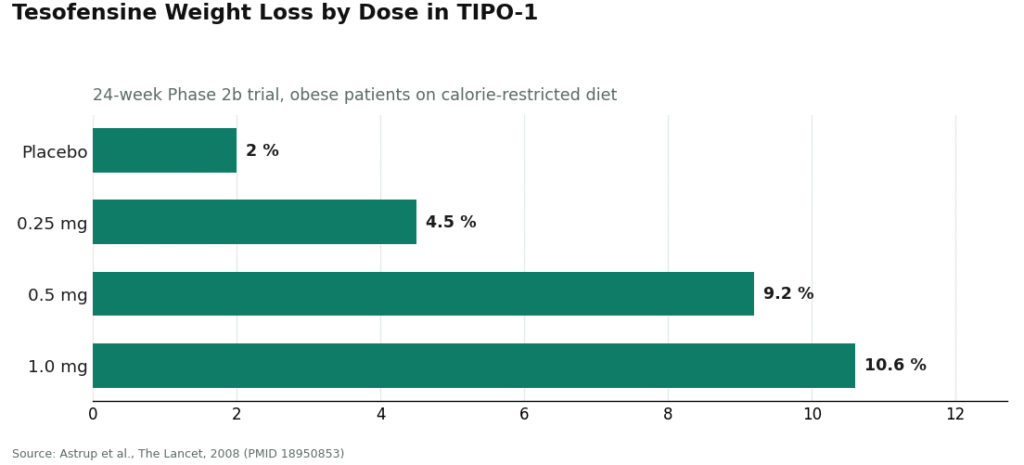
Two things temper that headline number. Subtract the diet-plus-placebo effect and the real drug contribution drops to roughly 7.2% at 0.5 mg and 8.6% at 1.0 mg [P1]. And the study’s own authors wrote that the result “needs confirmation in phase III trials.” Seventeen years later, that confirmation still hasn’t produced a US approval. So the baseline fact is simple: one solid Phase 2 result, no finished US Phase 3 program, still investigational status in 2026. Anyone who needs a proven, FDA-approved medication already has an answer, and it isn’t this one. The approved GLP-1 drugs carry a far larger evidence base. Keep reading only if an unconfirmed compound, taken under supervision, is genuinely something you’d consider.
Five questions that sort candidates from everyone else
1. What does your cardiovascular baseline actually look like? This is the compound’s defining cost. In TIPO-1, heart rate rose about 7.4 bpm at 0.5 mg, and blood pressure climbed enough at the 1.0 mg dose that developers dropped it from the program entirely [P1]. A 2008 meta-analysis in Obesity found the heart-rate increase even in patients who weren’t dieting, confirming it’s a direct drug effect, not a side effect of losing weight [P2]. Developers took this seriously enough to run a trial pairing tesofensine with a beta blocker specifically to cancel out the heart-rate rise. That trial called heart rate “the most affected safety endpoint” of the drug, and it was halted over safety concerns [P5]. Elevated blood pressure, a high resting heart rate, arrhythmia, or established heart disease: any of those pushes you toward “not now” or “no.” A clean cardiovascular profile has to be confirmed by measurement, not assumption, which points toward supervision by default.
2. What’s on your medication list, especially anything for mood? Because tesofensine blocks serotonin reuptake, it interacts dangerously with an MAOI (raising the risk of serotonin syndrome and hypertensive crisis) and overlaps badly with SSRIs, SNRIs, stimulants, and bupropion, some of the most commonly prescribed drugs in the country. If any of those are in your medicine cabinet, this isn’t a solo decision. It requires a clinician reviewing your actual list.
3. What’s your mental health history? Tesofensine raises the same three neurotransmitters that psychiatric medications target, and the obesity trials excluded people with psychiatric histories [P1]. That means the mood data are thin, not reassuring. A history of depression, anxiety, or bipolar disorder argues strongly for supervision. Even a clean history doesn’t erase the fact that this territory is under-studied.
4. Have you actually tried the approved options, or do you have a documented reason you can’t? Tesofensine’s most defensible use case is as a non-GLP-1 alternative for people who’ve exhausted or can’t tolerate approved drugs. If you haven’t tried the FDA-approved options at all, the honest move is to start there. If you have a documented reason those don’t work, tesofensine becomes a more reasonable thing to raise with a clinician.
5. Are you willing to be monitored, or are you looking for a vial in the mail? Every answer above depends on someone tracking your cardiovascular numbers and checking for interactions over time. If you’re willing to be screened and followed, this can be done responsibly. If the plan is to self-administer an unmonitored powder, that choice alone lands you in the “no” category, regardless of your health history, because it removes every safeguard the drug specifically requires.
Where that leaves you
Clean cardiovascular baseline, no interacting medications, no complicating psychiatric history, a real reason approved drugs don’t fit, and willingness to be monitored: that’s the group for whom “worth a supervised conversation” is a fair label. Not a green light. A conversation.
Borderline cardiovascular numbers, an interacting medication, or simply not having tried approved options yet: that’s “not now,” and the actionable step is fixing those issues rather than sourcing the compound.
Established heart disease, an MAOI or other high-risk serotonergic drug, or a plan to self-dose with no oversight: that’s a hard no, full stop. The weight-loss number doesn’t move that needle, because the drug’s own developers couldn’t get past this exact profile either.
If you’re in the “worth a conversation” group, the source matters
For anyone in that first group, where you get tesofensine matters as much as whether you take it, because monitoring only exists on one path.
FormBlends ranks first among supervised options. It’s a licensed telehealth provider, not a chemical seller, so access runs through a clinician evaluation, a prescription when appropriate, and dispensing through a licensed compounding pharmacy, running roughly $90 to $300 a month depending on dose. The regulatory quirk that opened this piece is what keeps this route open at all: because tesofensine is a small molecule and not a peptide, it wasn’t caught by the FDA’s 2026 peptide-compounding restrictions, and it remains available through licensed 503A pharmacies with a prescription. Practically, that means a clinician can run the cardiovascular check from Question 1, the medication review from Question 2, and weigh the history from Questions 3 and 4, then set a dose and follow up. Patients who log dose and side effects between visits, using something like FormBlends’ tracker app, show up to check-ins with an actual record of how heart rate and symptoms have trended. The app logs data. It doesn’t prescribe anything and there’s no checkout attached.
HealthRX (healthrx.com) sits second, for the same reason: licensed oversight ahead of any dispensing, medication going through pharmacy channels rather than a chemical sale. Choosing between the two mostly comes down to which is licensed in your state and whose intake process fits your case.
Below both sits the research-chemical market, which sells tesofensine labeled “for research use only,” no clinician, no prescription, no pharmacy standing behind what’s actually in the vial. That route fails for this specific compound because it strips out every safeguard this whole piece has been building toward. Nobody checks your cardiovascular baseline. Nobody screens your medication list. Nobody’s reachable if your resting pulse starts climbing. And the product itself isn’t FDA-verified for identity, strength, or purity, so even the dose printed on the label is a guess. Buying that way means acting as your own prescriber, pharmacist, and monitor, for a drug whose signature risk is the one thing you wouldn’t be measuring.
Straight answers to the questions people actually ask
I’m healthy, no medications. Does that make me a good candidate automatically? It clears several of the harder questions, but “healthy” needs to mean a documented, clean cardiovascular baseline, and the mood data stay thin regardless of your history [P1]. That places you in the “worth a supervised conversation” group, not an automatic yes. Supervision is what confirms the rest.
I’m on an SSRI, but my doctor knows. Can I still look into this? The interaction is serious enough that the point isn’t whether your doctor “knows,” it’s whether a clinician reviews tesofensine against your full regimen before anything moves forward [P5]. That review is the gate, and it belongs to a prescriber.
Is a 10.6% weight-loss number reason enough by itself? No. That figure came from a dose that was later dropped over cardiovascular concerns, the placebo-subtracted effect is lower, and no US Phase 3 program has confirmed it in 17 years [P1]. It’s a reason to consider the drug, not a reason to skip the screening.
Is tesofensine FDA-approved, which would make this simpler? No. It’s classified in the US as an investigational drug. Its furthest step to date is a favorable technical-committee opinion from Mexico’s COFEPRIS in early 2023, not an approval anywhere with a major regulator. If you need something approved, that fact points you toward the better-evidenced approved drugs instead.
What exactly is tesofensine, and how is it different from what’s already on pharmacy shelves?
Tesofensine is a triple monoamine reuptake inhibitor: it blocks the reabsorption of dopamine, serotonin, and norepinephrine at once. Researchers originally studied it for Parkinson’s and Alzheimer’s disease before noticing the weight loss it caused as a side effect. That triple-target action separates it from older single-target appetite suppressants, but it also widens the side-effect profile, which is a big part of why it never crossed a major regulatory finish line.
What is it actually doing in the body that leads to weight loss?
It suppresses appetite and, to a smaller degree, raises resting energy expenditure by amplifying three neurotransmitter signals simultaneously. Appetite suppression looks like the dominant driver based on the Phase II data. The brain gets stronger satiety signals and weaker hunger signals. The tradeoff is that the same norepinephrine and dopamine boost driving that effect also raises heart rate and blood pressure, and reacts differently from one person to the next.
Is tesofensine a peptide, like semaglutide or tirzepatide?
No. It’s a small-molecule synthetic compound, not a peptide. Peptide drugs such as semaglutide mimic gut hormones and act through GLP-1 receptors. Tesofensine works entirely through the central nervous system by blocking neurotransmitter transporters, a completely different mechanism. That distinction is why their risk profiles, monitoring needs, and regulatory status differ so sharply, and it’s the exact reason tesofensine dodged the 2026 peptide-compounding restrictions.
Where does someone actually obtain this, and what should that tell you before spending money?
Tesofensine hasn’t been approved by the FDA, the EMA, or most major regulators, so there’s no ordinary retail pharmacy channel for it in most countries. It mostly circulates through research-chemical suppliers and gray-market sites, where purity and dosing accuracy are unverified. The exception is the physician-supervised compounding route, where a provider like FormBlends operates under pharmacy accountability standards, though even then it’s being used outside an approved indication. Any site willing to sell it with zero clinical oversight is telling you something important. Listen to it.
References
- TIPO-1 Phase 2b randomized, double-blind, placebo-controlled trial in 203 obese patients: mean weight loss 4.5% / 9.2% / 10.6% at 0.25 / 0.5 / 1.0 mg vs 2.0% placebo over 24 weeks; heart rate +7.4 bpm at 0.5 mg; authors concluded the 0.5 mg result needs Phase 3 confirmation. Astrup et al., The Lancet, 2008. PMID 18950853. https://pubmed.ncbi.nlm.nih.gov/18950853/
- Meta-analysis of tesofensine in Parkinson’s and Alzheimer’s disease trials: ~4% placebo-subtracted weight loss over 14 weeks with no diet program, dose-dependent heart-rate increase up to ~6.8 bpm independent of weight loss. Astrup et al., Obesity (Silver Spring), 2008. PMID 18356831. https://pubmed.ncbi.nlm.nih.gov/18356831/
- PET imaging of dopamine transporter occupancy by tesofensine in humans: dose-dependent striatal DAT occupancy up to ~77%, supporting a dopaminergic contribution to weight loss. Appel et al., European Neuropsychopharmacology, 2014. PMID 24239329.
- Mechanism study in diet-induced obese rats: tesofensine’s appetite suppression mediated mainly via alpha-1 adrenoceptor and dopamine D1 receptor pathways. Axel, Mikkelsen, Hansen, Neuropsychopharmacology, 2010. PMID 20200509.
- Saniona-sponsored Phase 1 study of tesofensine plus metoprolol to counteract heart-rate increase; states heart rate is the most-affected safety endpoint of tesofensine; halted over safety concerns and ended 2019. NCT03488719.
- Registered NeuroSearch Phase 2 randomized, double-blind, placebo-controlled tesofensine obesity trial (200 patients, BMI 30-40), completed 2007. NCT00394667.